Passive and active immunisation
Calves, unlike humans, do not receive immune protection in the uterus. This means that they are born with no antibodies to ward off pathogens. The body’s own immune protection builds up gradually by itself. This process is also referred to as active immunisation. The first hours after birth are therefore crucial for a good start in life. The calf receives its first immune protection from its mother’s colostrum. It should be noted that the intestinal mucosa is open to immunoglobulins just six hours after birth. Antibodies which are relatively large enter the blood via the intestinal mucosa. This acquired (passive) immunity from colostrum (= passive immunisation) slowly reduces and will decrease considerably after four to six weeks. In this time, however, the calf’s own active immunity through contact with germs from the surrounding environment is not yet established.
Immunity gaps
Thus, in the first weeks of life, calves experience two immunity gaps (see Figure 1).
Figure 1: Immunity gaps in calves
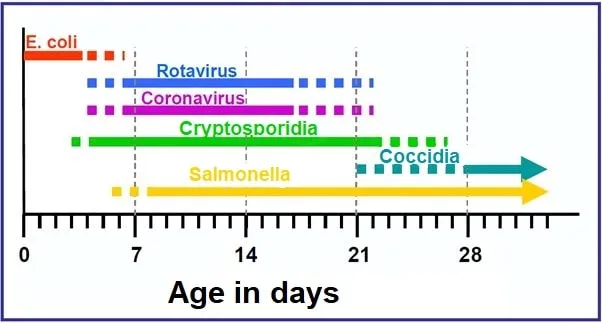
The first is immediately after birth and before ingestion of colostrum and the second is four to six weeks after that, when passive immunity is already beginning to subside, but active immunity is not yet established. If, during these times, the immune system is exposed to additional stress in the form of weaning, moving to a different stall, a change in feed, poor conditions in the stall or poor diet, diarrhoea pathogens find ideal conditions for intestinal colonisation (see Figure 2).
Often, protection from the colostrum is insufficient due to quality variations, even if the colostrum is ingested early enough. The quality of the colostrum depends on the number of lactations, the amount of milk initially ingested, the cell count and the season. Not every old cow produces good colostrum and not every young cow produces colostrum with low levels of antibodies. The only way to determine this exactly is with a colostrometer. In this sensitive phase, JOSERA Colostrin helps to close the gap. From the very beginning, it provides calves with immunoglobulins, lactic acid bacteria, vitamins and important trace elements. It is always advisable to avoid unnecessary stress and to feed animals in a balanced way. JOSERA milk replacer Brillant and GoldenSpezial are ideally suited for the second immunity gap
Conclusion
The limiting factor in terms of performance in our dairy cows is feeding capacity, because from a genetic point of view their performance potential has not yet been exhausted. Calves are the cornerstone for future high milk yields. If, for example, the intestinal tract is irreversibly damaged by premature diarrhoea, the animal’s absorption of nutrients from the intestine is often very limited. This means that diarrhoea can have a significant impact on the animal’s later performance and leads to future financial losses! Every effort should therefore be made to close the two immunity gaps in calves.