Ad Libitum Feeds
The term ‘ad libitum feed’ refers to freely available feeds of milk or milk replacer. This type of feeding should be limited to the first weeks of life. The recommendation to administer the ad libitum feeds over the first three to four weeks is based on the fact that the digestive system of the calf is designed to recycle milk at the beginning of its life. The change to solid feed, and accordingly to a ruminant portion, takes its time. Nevertheless, the calf must be able to absorb the necessary nutrients, because otherwise the calves’ susceptibility to various diseases increases and their optimal development may be impaired.
Restrictive feeding
With restrictive feeding, the calf receives a feed quantity that is allocated to it according to a fixed feeding plan. Due to a particular feeling of hunger created in this way, the calf should be encouraged to start eating solid feed as soon as possible. Initially, only small amounts of feed are consumed, but they do, however, play a particularly important role in the formation of the enzymes required for digestion.
Depending on the feed quantity and milk replacer concentration, restrictive feeding may result in the calf not being able to meet its energy requirements with the quantity allocated to it. This can lead to lower weight gain if no high-quality supplementary feed is offered by way of compensation or the calves do not consume sufficient quantities.


Costs
The cost of ad libitum feeding should also not be underestimated. Milk is a very expensive foodstuff. The intake of solid animal feedstuffs is delayed due to the high milk intake, so more money has to therefore be invested in feeding. Whether a decision is made for or against ad libitum feeding depends, in principle, on individual opinions and the operational conditions. Ad libitum-fed calves should be kept in individual pens during the first 3 weeks of life and milk should be freely available to them at all times. It is then possible to switch to group rearing and gradually reduce the quantity of milk so that the calves are weaned from the milk at an age of approx. 10 weeks.
Conclusion
The fact is, you can raise calves using either method. With restrictive feeding, care must be taken to ensure that the concentration of the milk replacer is sufficiently high. With ad libitum feeding, there must always be enough milk available during the first few weeks so that it can be consumed at will. It is always important that the calves quickly start to eat solid food so that the rumen can develop well. Therefore, the calves should be offered solid feed as early as possible, even if intake is still limited in the first few days. Special calf mueslis are particularly suited to this, because they are very tasty and well received by the calf.
Ad libitum feeding in calf rearing – does it pay off?
This is illustrated by the results of a feeding experiment carried out by JOSERA in cooperation with the Weihenstephan-Triesdorf University of Applied Sciences.
Key data
- 43 Simmental calves
- 2 Groups
- Ad libitum feeding for 4 weeks
- Restrictive feeding with 6 litres/day
5 weeks JOSERA IgluVital milk replacer powder
Another 7 weeks with JOSERA Optimil milk replacer powder
The experiment
1. Ad libitum – Group
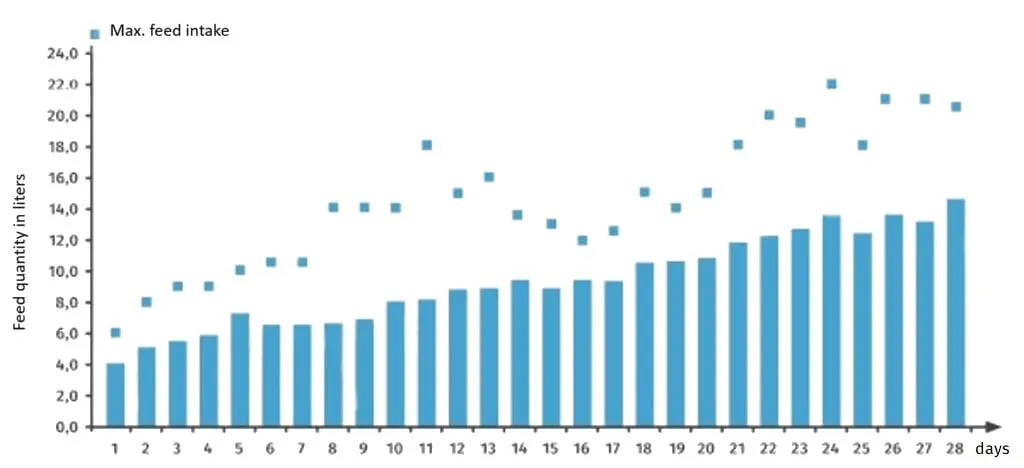
The average feed intake increased to 14.6 litres per day in the first four weeks. Individual animals had up to 22 litres per day in the fourth week of life. This confirms that the IgluVital (milk replacer powder) has great palatability and is well tolerated in very high feed quantities.
3. Higher milk yield through ad libitum calf feeding?
Numerous scientific studies have confirmed the importance of intensive rearing and the associated higher profitability in dairy cattle farming. It essentially comes down a change in attitudes in practice. Investments in a new-born calf, especially in the first weeks of life, are always worthwhile.
The following table shows the link between the higher daily gains during the feed phase and the higher milk yield in the 1st lactation.

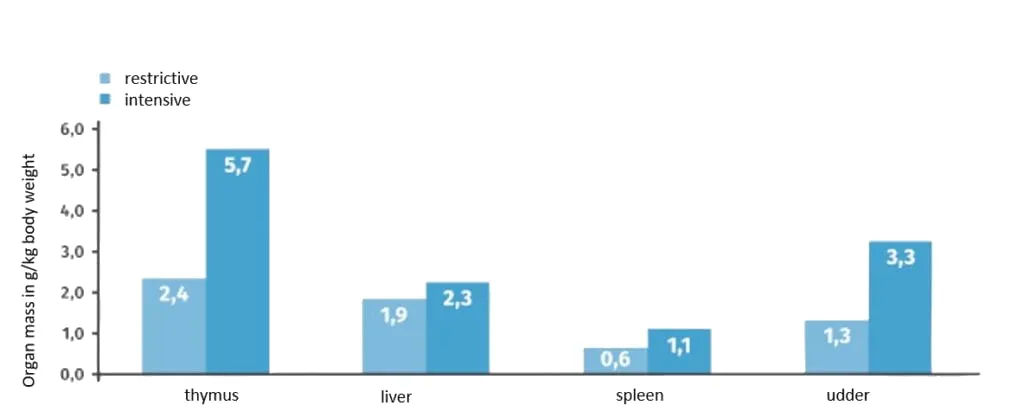
Positive maturation of organs in calves
The results of an American study at the University of Blacksburg illustrate the effects of metabolic programming.
Content of the study:
Two trial groups were fed either restrictively or intensively over a period of 8 weeks.
Result:
The intensively fed calves were, by the 8th week of life, 24.5 kg heavier than the restrictively fed animals.
A comparison of selected organs showed a significantly higher organ mass per live weight kg in the intensively fed calves.
Conclusion:
This means that certain organs generate a higher cell growth in relation to the whole body during an intensive nutrient supply.
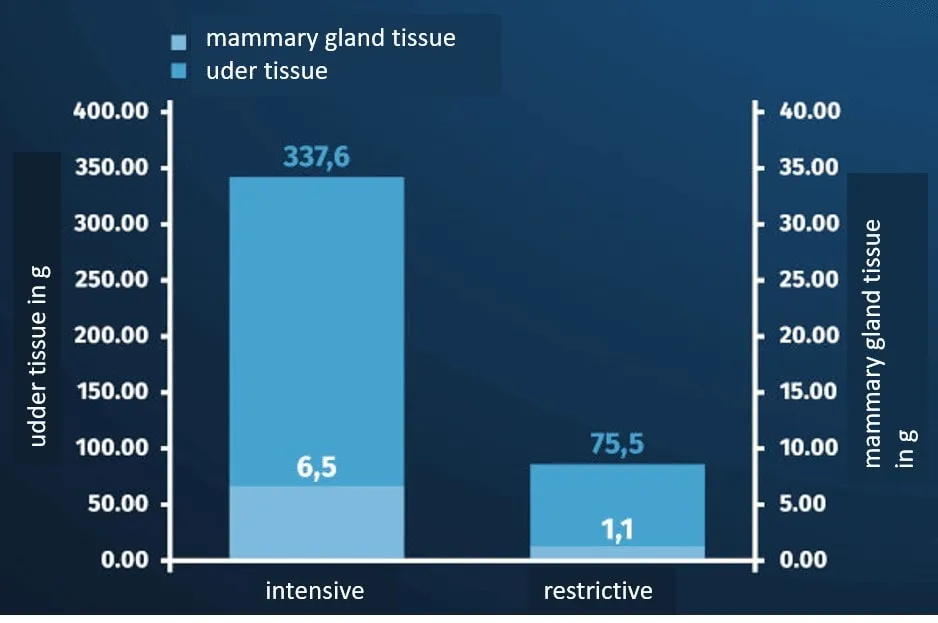
Positive development of udder tissue in calves
Soberon and Van Amburgh (2017) were also able to prove the effect of metabolic programming on the development of udder tissue.
Content of the study: Feeding trial with two trial groups, one of which was fed restrictively with 0.6 kg milk replacer powder/day and the other fed intensively with 1.3 kg milk replacer powder/day.
Result: The results of the histological examination in Fig. 4 clearly show that on the 54th day of life, in comparison to the restrictively fed animals, the intensively fed animals exhibited udder and mammary gland tissue that was significantly larger.
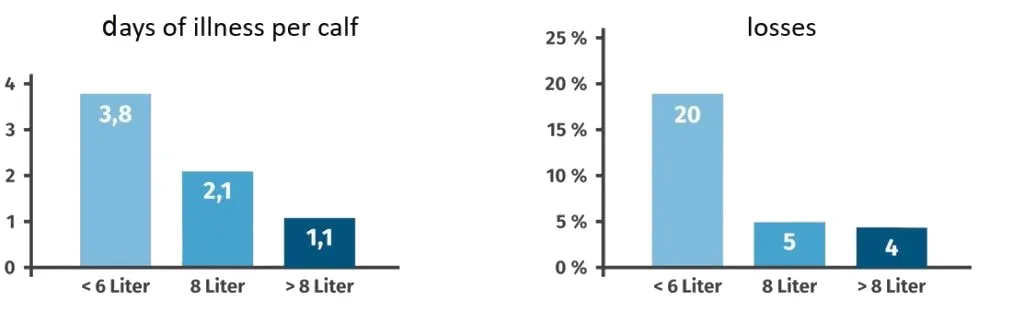
Positive effect on health of calves and later lifetime production of the dairy cow
In a study with 532 calves, Schuldt and Dinse (2016) showed that calves with a higher milk substitute intake have a lower incidence of disease. In addition to the influence of the metabolic programming this also has a positive impact on the performance of the dairy cow in later life.
The test results in brief
The test results in brief:
- On the 28th day of life, the feed intake of the ad libitum group reached an average 14.6 litres/day (max. 22 litres/day).
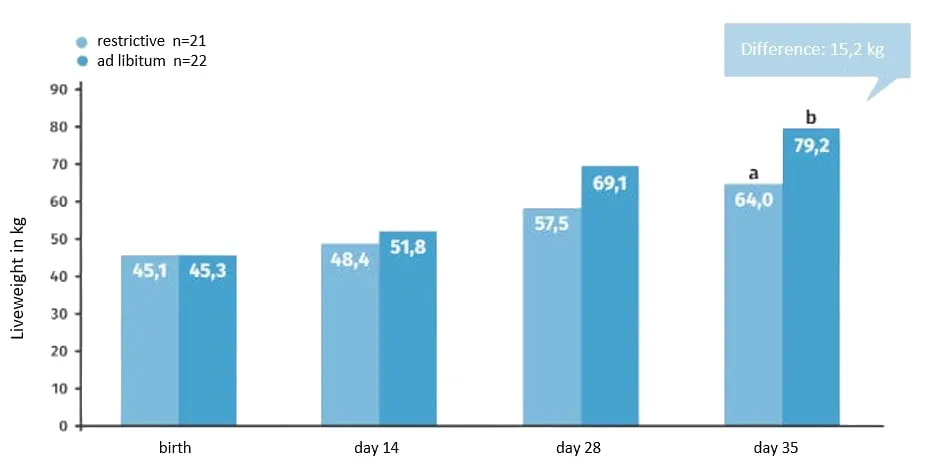
- On the 35th day of life, the difference in weight between the two trial groups was, on average, 15.2 kg in favour of the ad libitum group.
- When weaning on the 86th day of life, ad libitum-fed calves maintained an average weight advantage of 8.4 kg.


JOSERA recommendation for ad libitum calf rearing
- After birth, at least two feeds of colostrum with 3-4 litres per feed should be taken. The colostrum should be milked immediately after birth and administered to the calf.
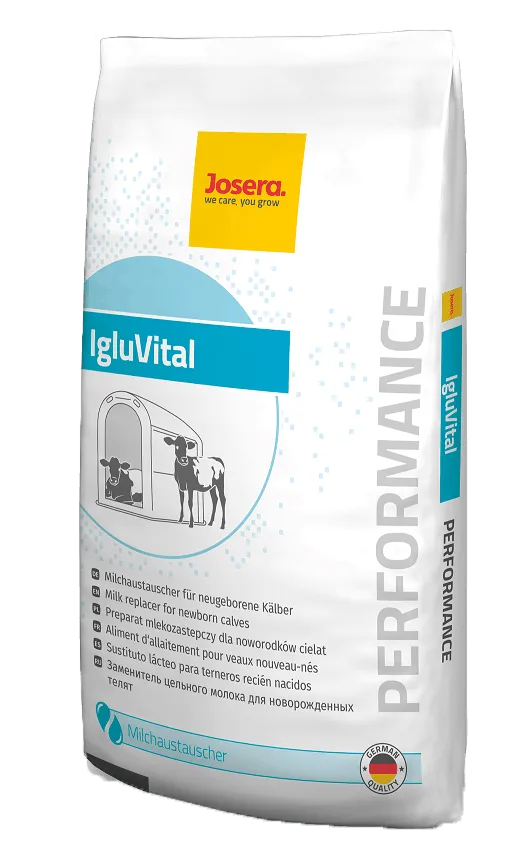
→ Read our guide to rules for managing the birth of your calf. - To achieve a good nutrient supply during the first four weeks of life, we recommend JOSERA IgluVital milk replacer powder.
- During the further feed phase, it is possible to switch to a cheaper milk replacer powder.
- For good rumen development, solid food and water should be freely available during the first weeks of life.
- To avoid the multiplication of germs in the feed trough, the feed buckets should be rinsed twice a day with warm water.
→ Please read our guide to Hygiene in the calf stall. - With high external temperatures and a longer residence time spent at the feeder buckets, additional acidification of the troughs using VitalAcid is recommended so that a pH value of 5.5 can be reached in order to suppress the multiplication of coliform bacteria.

Feeding plan for ad libitum calf rearing
Important!
It should be noted that later husbandry and feeding errors also have a negative effect on lifetime production and can therefore compensate the positive effects of intensive calf rearing. For this reason, care must be taken to ensure that the supply for further rearing of young cattle is in line with demand so that optimum conditions can be guaranteed, particularly during the laying-in and calving period.
How does intensive calf rearing affect the milk yield of dairy herds?
Through intensive calf rearing, calves are metabolically programmed, organ development is improved, and first insemination can be achieved earlier, thus resulting in a higher milk yield.
How does intensive calf rearing work?
The feeding buckets should always be filled to such an extent that, if possible, the calves have enough feed until their next meal.This is what JOSERA recommends!
How does cell growth and cell division work in calves?
Here, you will learn how cell division (hyperplastic growth) works in the first weeks of life and cell growth (hypertrophic growth) takes place in later rearing.
What would a sample feed plan for intensive calf rearing look like?

How is cell division regulated in the early growth phase?
The nutrient supply regulates the cell division rate in the early growth phase, so that organ development and thus the performance of the dairy cow in later life is “programmed” via the intensity of feeding.
What is the recommended pH value for the acidification of milk?
The recommended value for the acidification of the milk is pH 5.0–5.5.
How much does a calf drink on average?
The experiment has shown that the feed volume increases to an average of 14.6 litres by the fourth week of life. This means that when milk is freely available, a calf drinks an average of 14.6 litres/day until the 4th week of feeding milk replacer.
Isn’t it the case that ad libitum feeds result in faulty fermentation?
A study by Ellingsen (2015) shows that the feed capacity of the abomasum is far greater than the 2-3 litres originally suspected. This also means that no faulty fermentation occurs as a result of the intensive feeding of calves.
Is the ad libitum feeding economical?
A feeding trial has shown that the cost of the higher feed expenditure of 21.6 kg of milk replacer powder is already compensated for by the 35th day of life as a result of the increase in yield of 15.2 kg live weight. This advantage comes into play immediately when the calves are sold. However, the greater economic benefit results from an earlier age of first calving and an increased milk yield during the later lactation phase of the dairy cow.